

Look at all this praise for stuff I didn’t even mean to do.
What we can learn from Zach Cregger’s vibes-based writing. (Weapons, Barbarian)

This article contains modest spoilers for the films Weapons and Barbarian. The most explicit spoilers will be clearly marked. If you’d like to go in blind, skip this one and just give me $16 for my trouble instead.
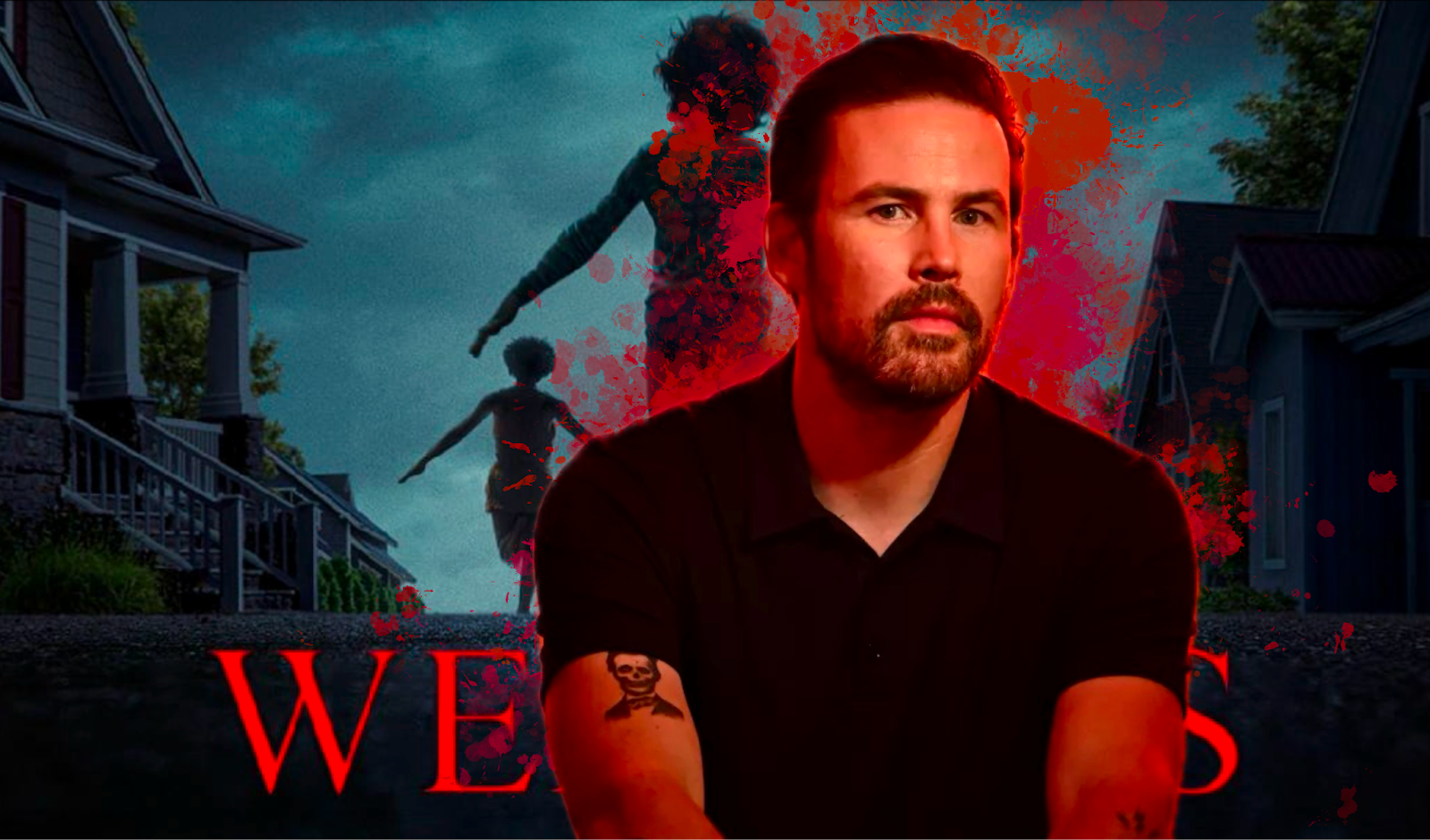
“If I intellectualize it, it’s dead.” — Zach Cregger.
A few weeks ago, I heard the unmistakable sound of desperate claws on porcelain. My 15-week-old Kitten, after much fascination with the object, fell into the toilet. We had been trying to curb her interest and also keep the lid closed, but alas, the circumstances dealt that night led to ruin, and the next half hour of my life was spent mopping up the floor, drying her off, and ignoring the game of Among Us I was supposed to be playing with my friends. These details are strictly speaking not important to the point I’m making in this writing craft letter today. But I included them because I had the instinct to, and that is precisely how the writer/director of the hit movie Weapons, Zach Cregger, seems to approach storytelling.
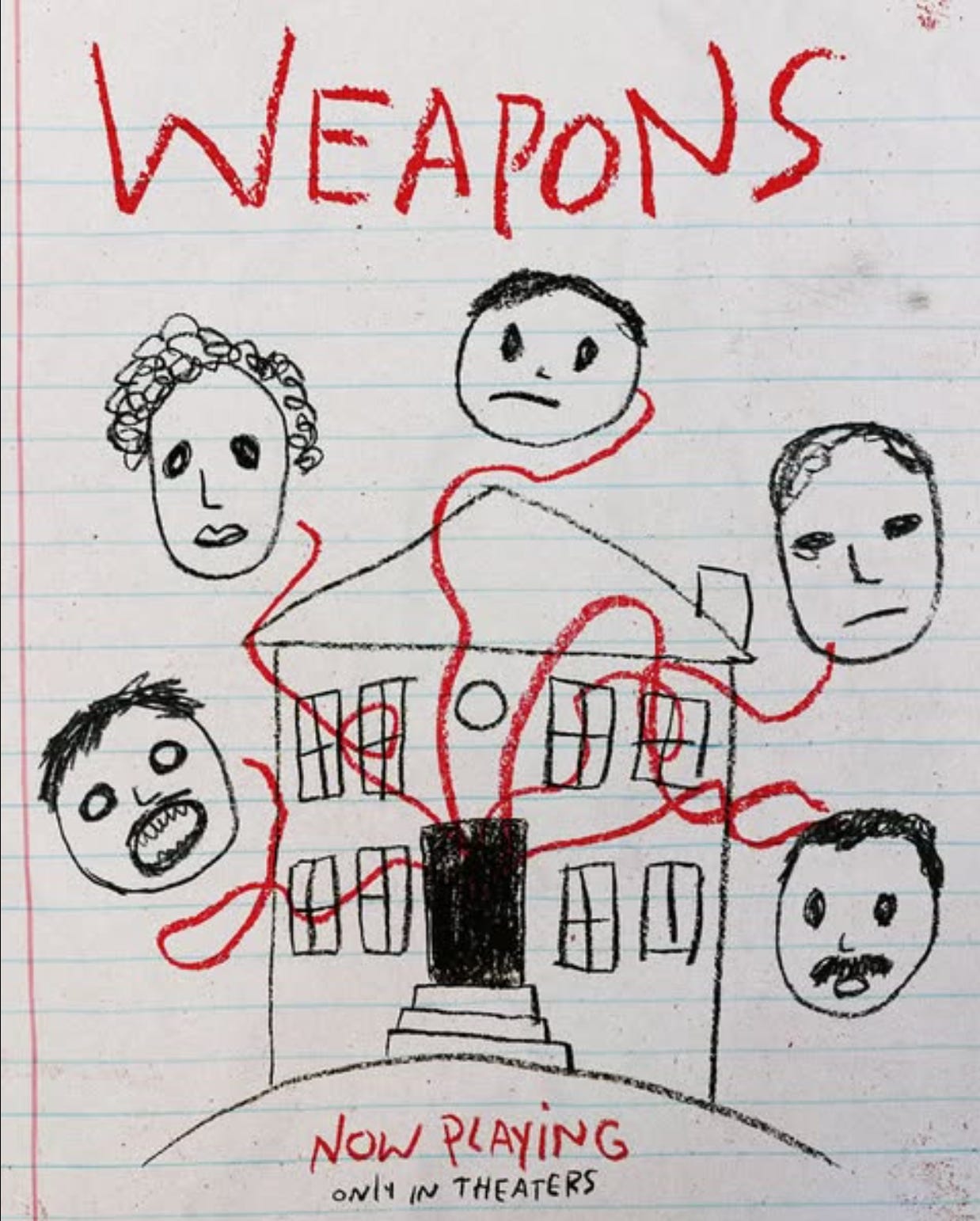
For those unfamiliar, Weapons, the critically and commercially successful horror movie that came out last month, follows a small town dealing with the fact that 17 kids from the same elementary school class got out of their beds at 2:17 a.m. and disappeared into the night.
There was a lot of hype for Weapons long before its release, with rumors swirling that Jordan Peele allegedly fired members of his management team for losing the bidding war to produce the film. My review of Weapons is that it rips. It is utterly captivating from start to finish. The lobby was abuzz after my showing, and it prompted a vivid thematic discussion between my partner and me during the car ride home. But I do, however, find myself agreeing with the few negative reviews that claim it isn’t really about anything.
Zach Cregger is an undeniably talented director and craftsperson, though with both this and his previous surprise hit Barbarian, he has proven himself to be a primarily vibes-based writer. Both films have invited much discussion about the deeper political themes at play, with countless reviews, discussion boards, and podcasts piecing together the works’ messages as Cregger weaves horrific imagery with the apparent backdrop of contemporary societal issues.
With Weapons specifically, one of the most common interpretations, as many reviews have argued, is that the film is about school shootings. Without getting into too many specifics, the film follows various folks from the town dealing with the tragedy of this missing classroom full of kids, with a father of one of the missing kids at some point seeing a seemingly blunt piece of imagery of a giant AR-15 floating in the sky during a dream sequence. With those dots there, this was also the lens through which I viewed the film for much of its runtime, but when the credits rolled and days passed, I struggled to surface any coherent ideas on school shootings from the work.
During an interview with The Playlist about Weapons, Cregger explicitly says he was not trying to comment on or even tap into collective societal tragedies. “I was purely writing from a personal place… I’m more than happy if anybody relates to what I went through and what this movie is examining, but I wasn’t thinking ‘oh, America’ at all. I was thinking ‘oh, Zach.’” He further told Last Podcast on The Left, “This is such a personal movie. There’s no overarching lesson… I have nothing to say with this movie, I have no pretense of like 'this is a treatise'—it’s just a diary entry for me.”
Now the discussion of whether to prioritize authorial intent or reader interpretation is a big ol’ slice in the literary criticism field pie. The wider discussion is more than we can eat today, but this is a newsletter about writers. And I’m fascinated by the mechanism that allows a writer without thematic intent to make something that prompts the level of discussion that Weapons has. Because there is a difference between Weapons and something like Fast & Furious Presents: Hobbs and Shaw, where the only point is to make the Rock/Jason Statham look cool while punching Idris Elba. To me, Cregger has an odd mix of storytelling skills that places his films between pulpy entertainment and analysis-worthy works of art.
Cregger wrote Weapons after the unexpected passing of his longtime friend Trevor Moore, comedian and co-founder of The Whitest Kids You Know sketch group (Yes, it’s the same Zach Cregger). There is deep personal meaning in the script, evident in discrete sections. Both from the text of the film and from statements from Cregger, we can see various forms of grief represented in the work with Julia Garner's character's alcoholism or Alden Enrenreich's self-destructiveness. Through these presentations, the movie is not necessarily trying to make a definitive statement or value judgment on a specific thematic idea.
Cregger does, at least in part, play coy in interviews, and doesn't like to give definitive answers on the meaning of certain elements of his works—a practice I respect. But it's also clear that he does, in general, prioritize his early ideas and tries not to pick apart his instincts. He says that he likes to eliminate himself from the creative process, preferring to see himself as a conduit to his creativity. “If I intellectualize it, it’s dead, so I try just to turn my brain off and let my subconscious go, and that’s when the best stuff comes, and then I don’t really need to second-guess it. It’s a little woo-woo, but I really believe in it,” he again told The Playlist.
To be clear, Cregger is very much a craftsperson. Like a cat using all of its strength to climb out of a slick bowl, it’s obvious there is effort in his work. After getting a big mess of pages down, Cregger says he does the writer thing of turning on his craft brain to edit until the story is ready. But it’s interesting to go through that process without starting to edit towards an “intellectualized” handful of clear thematic ideas. Even if they are emergent during the writing process, developing the messages you, the writer, want to communicate means you have a lighthouse guiding the ship of your story as you move into the editing process. Does this character/scene/sentence lead us towards the path of the thematic lighthouse? No? It’s gone.
What I’m getting at, really, is that Cregger likes to put what is interesting to him on the page, and then, unlike many storytellers, he does not tear into those interests with tweezers and needles to where he’d have the potential to demystify himself. He doesn’t take apart his instincts like an owl pellet, which has resulted in an authentic film that represents Cregger by virtue of his trusting that what is interesting to him will be interesting to others.
I’m a big believer in artists caring for the craft enough to make the effort of being understood. Many artists throw out a bunch of shit that they enjoy and hope that people receive it without first doing the work of translating their thoughts. But what makes Weapons work (again, I think this movie fucking rips) is that it is an intentional philosophy. Cregger’s other storytelling skills of timing, character writing, shooting a suburban hallway to evoke maximum dread, and building to bombastic moments mean that he can get away with throwing together a mishmash of instincts and outputting a story folks can both find entertaining and draw deep meaning from.
It’s not that Cregger doesn’t have a lighthouse; it’s that his instincts are the lighthouse. His other technical skills then give his ship a strong enough foundation to keep things afloat.
This next section has the most explicit spoilers for both Weapons and Barbarian if you’d like to skip to the end.
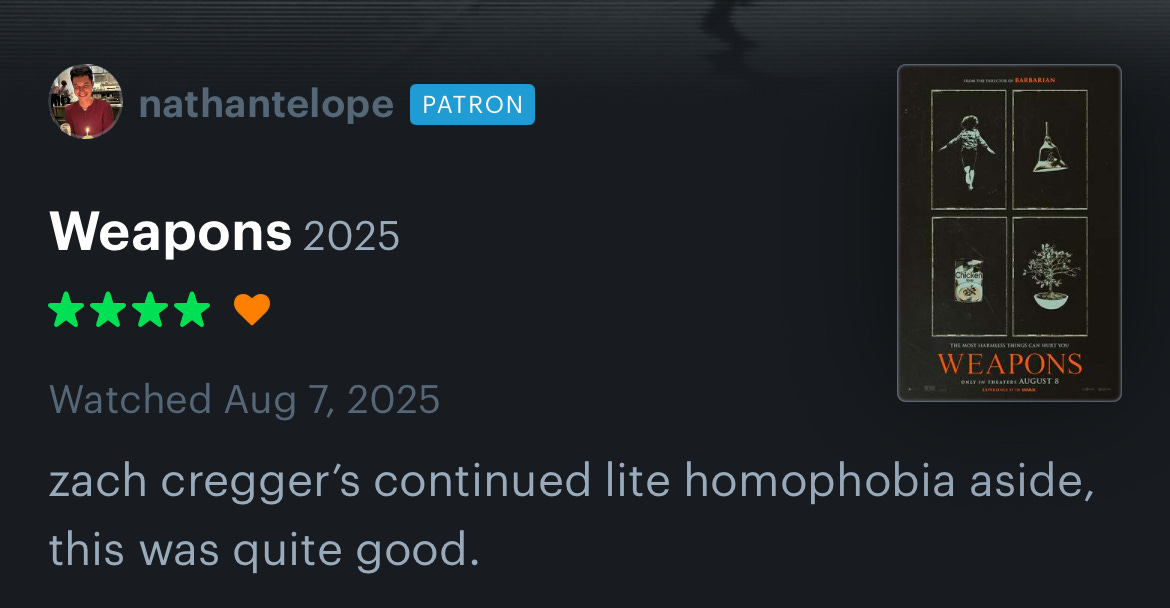
There’s a lot I admire about Cregger’s creative methodology. But the danger with an instincts-first approach is that you can stumble into some pitfalls that you could otherwise avoid.
Major spoilers, but the answer to what happened to the kids is that a witch did it. She possessed them and put them in the basement to help her stay alive. The ride to that reveal is very fun, but the nature of her villainy is metaphorically mixed, and the movie spends more time on the literal mechanics of what happened than on what it all means.
The witch’s abuse of the main child, whose house she uses as her base in the film, and the way she turns his parents into unrecognizable husks of themselves harkens to a child growing up in a house with addicted parents. But when she’s harming other people in the town, she’s not thematically representing that idea anymore. Benedict Wong’s character plays out the much-maligned bury your gays trope when the witch, Gladys, magically forces him to brutally kill his husband right after the latter is introduced, bashing his head in and covering Wong with blood. When I saw this happen in the movie, I didn’t take issue, since I was waiting to see what the film had to say about this type of violence for the only gay characters in the movie. But again, not much came of it on any deeper level.
When someone levies the critique of a film employing the bury your gays trope, it’s not to say that gay characters can’t die in film, especially a horror movie, but without the thematic nature of the villain being that parseable, there isn’t too much thematic meaning in the moment, aside from the plot functional aspects of making the possessed Benedict Wong look scary and the villain be hateable. As a result, Cregger plays into a much-hated and tired trope without much critical thought.
Similarly, in Barbarian, there is a moment where a homeless man is beaten to death with his own arm in a moment fully devoid of meaning other than the fact that Cregger thought it would be neat or funny. Cregger is also two-for-two in making the monsters in his movies characters who just have the bodies of old women. As my friend, Variety reporter Selome Hailu says, it’s reasonable to interpret Cregger’s message with Gladys to be nothing more than that “old women are ugly and evil lol.”
—Explicit spoilers end—
These factors don’t make me want to dismiss the films outright, nor would I inherently be against similar choices made intentionally. However, given Cregger’s style, it seems that the more unfortunate aspects of his films are a side effect of his creative approach.
Many great stories buckle as they overanticipate every potential angle of criticism and storytellers don't need to spell out their ideas in clear bold letters, but all the same, when you abdicate the process of “intellectualizing” your work you can end up with the type of warts you see in Weapons and Barbarian, and too can miss out on that extra layer of resonance that can come with more defined thematic goals.
Considering those critiques, I still think Cregger is an exciting and unique storyteller (have I mentioned I think this movie rips?). I respect that he is attuned enough to what is genuinely interesting to him and that he has the confidence to preserve those elements as the filmmaking process labors on. I think it’s worthwhile for every creative to consider where they land on that spectrum of being a conduit for creativity and being a meticulous iterater. As the inverse of Cregger is someone who second, third, and fourth-guesses their instincts and overnotes themselves until all of their raw creative instincts are gone by the final draft.
It’s a fascinating approach to storytelling. If you’re looking to adopt it, though it’s worth noting that sometimes our instincts lead us to being handed the keys to the Resident Evil franchise, and sometimes they lead us to falling into the toilet.
.
.
Thanks for reading! What a fascinating movie Weapons is. Let me know your thoughts on the film below. More next time!
More words to read!


Yes yes yes
I'm very curious to see Weapons (more so now after this review, since previously my only reference point was Alisa's mom who didn't know it was a horror movie going in and hated it lol) — but in general I feel like vibes based storytelling (also not something I had a name for before, so thank you for that!) is kind of offputting to me. I find it pretty frustrating when it feels like there is a theme or message right there, and the writers just don't land it. That was exactly how we felt coming out of Caught Stealing recently. I guess it does change things to know though that the writer wasn't trying lol. I guess that just raises the question of whether having a message in a story is better than not, which I would hesitate to say definitively, but I think is definitely my preference. A lot to think about!